I don't usually write about current events on my blog pages. I usually write about long-term trends in politics, economics, religion, or one of the social sciences, but this topic is important to me, and it is difficult to explain it adequately on Twitter.
These are the first two paragraphs of an August 3, 2015 article in The Washington Examiner. The link in the second paragraph was in their article.
These are the first three paragraphs of a July 1, 2015 Christian Science Monitor story. All of the links in these paragraphs were in their story.
These are the first four paragraphs of a January 17, 2016 Politico article.
The End of Racism, published June 22, 2012
The Beginning of Color-Blindness, published June 18, 2014
Later in the campaign season, this disturbing trend (Donald Trump's popularity with Democrats) was verified by other polls. These are the first paragraphs of a January 9, 2016 article in The Hill.
This March 25, 2016 article in the Washington Post goes into a lot of depth to compare his appeal with the appeal of certain European political parties, based on their shared views on illegal immigrants. The headline of this article predicts a victory for Hillary Clinton in November, based on the analysis in the article. I will discuss this prediction later in this essay.
This conclusion is also shared by Nate Cohn, who is the writer of a March 26, 2016 article in the New York Times. Here are the first three paragraphs. The link in the second paragraph was in his article.
These are the first two paragraphs of a June 25, 2016 Red State article.
If this is true, and I believe that it is true, one has to ask two very important questions.
Why would a Democrat vote for anyone who wants to
These are the 8th through the 11th paragraphs of a biography page of the U.K. History Channel. The links in these paragraphs were in their article.
Donald Trump disagrees with how the Republican Party is organized, just like Adolph Hitler disagreed with how the German Worker's Party was organized in 1919.
 Many people have come to Donald's speeches for the same reason that they came to Hitler's speeches. They wanted to hear him speak.
The photo on the left was posted on September 22nd on the Twitter account @JimLibertarian.
Many of Donald's supporters leave his speeches in a state of near-hysteria, willing to do whatever he suggests.
Donald quickly rose through the 2015-16 campaign season to become the nominee, and there is evidence that people were bullied into accepting his terms, which is what happened to Germans in the 1920s.
These are the first five paragraphs of an April 22, 2016 Politico story.
These are the last two paragraphs of a June 10, 2016 Time Magazine story.
Donald Trump has his own set of violent supporters. I met some of them when I made a one-day campaign in April 2016 to become a Delegate to the Republican Convention that met in July in Cleveland, OH.
These are the first three paragraphs of a July 22, 2016 article in the Cleveland edition of The Patch.
These are the first four paragraphs of a June 3, 2016 Washington Post story. The link in the third paragraph was in their story.

These are the first three paragraphs of a March 11, 2016 Los Angeles Times story. The links were in their story.
Donald's supporters are acting too much like Adolph's supporters did in the 1920s and the 1930s.
I fear for the safety of my country if he is elected, so I will exercise my legal and moral right to write the name "Ted Cruz" onto my ballot in November.
These three paragraphs are part of the obituary for Adolph Hitler that was published by the New York Times on May 2, 1945.
I put the caption on this photo myself, but the words are a paraphrase of words that he himself spoke.

More information about my reasons for voting for Senator Cruz are available in this May 2016 American Thinker article.
I wrote two long blog pages in early August 2016. They list, in detail, my reasons for not wanting to vote for Hillary and my reasons for not wanting to vote for Donald.
Donald Trump's surprising popularity
Very early in the 2016 campaign season, there were disturbing signs that Donald Trump would be popular among voters in both of the two major political parties.These are the first two paragraphs of an August 3, 2015 article in The Washington Examiner. The link in the second paragraph was in their article.
If Donald Trump gets bumped out of the Republican primaries and runs as an independent third party candidate, 36 percent of Republicans and a whopping 19 percent of likely Democratic voters would support him, according to a new poll.
Rasmussen Reports on Monday said that a Trump third party bid would complicate the presidential election even more than it did when H. Ross Perot ran in 1992, a bid that many believe cost former President George H.W. Bush a second term.
These are the first three paragraphs of a July 1, 2015 Christian Science Monitor story. All of the links in these paragraphs were in their story.
It's the early election surprise no one saw coming: in poll after poll, Donald Trump is surging.
The latest, a CNN/ORC national poll out Wednesday, has Mr. Trump in second place among Republicans, behind former Florida Gov. Jeb Bush, one of only two Republicans with double-digit support.
The poll echoes similar polls by Fox News, Suffolk University, and Quinnipiac University, all showing Trump in second place either nationally or in select early primary states like New Hampshire and Iowa.
These are the first four paragraphs of a January 17, 2016 Politico article.
If I asked you what most defines Donald Trump supporters, what would you say? They’re white? They’re poor? They’re uneducated?
You’d be wrong.
In fact, I’ve found a single statistically significant variable predicts whether a voter supports Trump—and it’s not race, income or education levels: It’s authoritarianism.
That’s right, Trump’s electoral strength—and his staying power—have been buoyed, above all, by Americans with authoritarian inclinations. And because of the prevalence of authoritarians in the American electorate, among Democrats as well as Republicans, it’s very possible that Trump’s fan base will continue to grow.
Note: The author of this article describes some people as being "white". This is a technical term in a concept called "separate races of people". I have proven beyond a reasonable doubt that this is a false concept because it contradicts itself. This is proven in the first of these two blog essays. The second essay was written for people who have seen and accepted the contradictions that are necessarily caused by a limited supply of biological races.
The End of Racism, published June 22, 2012
The Beginning of Color-Blindness, published June 18, 2014
Later in the campaign season, this disturbing trend (Donald Trump's popularity with Democrats) was verified by other polls. These are the first paragraphs of a January 9, 2016 article in The Hill.
About 20 percent of likely Democratic voters say they would buck the party and vote for Republican presidential candidate Donald Trump in a general election, according to a new poll.
The willingness of some Democrats to change sides could be a major problem for Democratic front-runner Hillary Clinton this fall.
The new figures were released by Mercury Analytics, a research company with clients that include MSNBC and Fox News, as the result of an online poll and dial-test of Trump’s first campaign ad.
A smaller number of Republicans say they’d vote for Clinton — about 14 percent.
This March 25, 2016 article in the Washington Post goes into a lot of depth to compare his appeal with the appeal of certain European political parties, based on their shared views on illegal immigrants. The headline of this article predicts a victory for Hillary Clinton in November, based on the analysis in the article. I will discuss this prediction later in this essay.
This conclusion is also shared by Nate Cohn, who is the writer of a March 26, 2016 article in the New York Times. Here are the first three paragraphs. The link in the second paragraph was in his article.
The Republican establishment typically has a dependable ally in the primaries: the blue-state Republicans. They’re relatively affluent, well educated, moderate and secular, which usually makes them a natural partner to offset the more populist, religious and conservative outsider candidates who often rally the party’s Southern base."... Mr. Trump’s blue-state appeal is a little hard to explain."
But this year, blue-state Republicans have abandoned the establishment for Donald J. Trump. So far, Mr. Trump has won every non-caucus contest in a state carried by Barack Obama in 2012, with the exception of John Kasich’s home state, Ohio. Mr. Trump is expected to win in California and along the Acela Corridor, which vote in the second half of the primary season. If he eventually gets a majority of delegates to the Republican convention, it will be because of the 15 or so most reliably Democratic states.
But Mr. Trump’s blue-state appeal is a little hard to explain. It’s well established that he fares best among less educated voters. Yet his strongest performance so far wasn’t in Mississippi, where he got 47 percent of the Republican vote, but in Massachusetts, a famously liberal state, where he won 49 percent of Republican voters.
These are the first two paragraphs of a June 25, 2016 Red State article.
After a lot of work I have finished my math calculations. A simple effort will show that from 2000 to 2008 there was a change in Primary votes of 10-12 million. Ten million more Republicans and 12 million less Democrats. But this is child's play. Getting deeper, examining States with close polling prior to the registration requirements, States with a clear winner in polls prior to registration change requirements, and you can set patterns."Trump only got about 3.3 million Republican Votes. The rest are Democrats, approximately 12 million of them."
Using 2000 and 2008 as baselines, the conclusion was staggering. Trump only got about 3.3 million Republican Votes. The rest are Democrats, approximately 12 million of them.
If this is true, and I believe that it is true, one has to ask two very important questions.
Why would a Democrat vote for anyone who wants to
- build a wall that is intended to stop immigration from Mexico and Central American countries? Democrats believe that these people are poor and hungry, so they should be welcomed into our country and then given food, clothes, and shelter as an act of love for our brothers and sisters in other countries.
- stop members of "the Religion of Peace" from entering the United States? Democrats believe that the vast majority of these people are a persecuted religious minority who have no plans to harm anyone.
The similarity with a European politician
This section was added on September 23, 2016.These are the 8th through the 11th paragraphs of a biography page of the U.K. History Channel. The links in these paragraphs were in their article.
In 1919, Hitler attended his first meeting of the German Workers' party, an anti-Semitic, nationalist group as a spy for the German Army. However, he found he agreed with Anton Drexler's German nationalism and anti-Semitism. He disagreed with how they were organised leading him to make a passionate speech. Hitler quickly cemented his reputation as an engaging orator through his passion about the injustices faced by Germany as a result of the Treaty of Versailles.Just because history is uncomfortable to read doesn't mean that the history is inaccurate or irrelevant to people who are alive and politically active today.
It soon became clear that people were joining the party just to see Hitler make his speeches, which would leave the audience in a state of near hysteria and willing to do whatever he suggested.
He quickly rose through the ranks and, by 1921, was the leader of the re-named National Socialist German Workers' Party (Nazi).
With terrible economic conditions and rapid inflation, support for Hitler's party grew. By 1923, the Nazi's had 56,000 members and many more supporters.
Donald Trump disagrees with how the Republican Party is organized, just like Adolph Hitler disagreed with how the German Worker's Party was organized in 1919.
 Many people have come to Donald's speeches for the same reason that they came to Hitler's speeches. They wanted to hear him speak.
The photo on the left was posted on September 22nd on the Twitter account @JimLibertarian.
Many of Donald's supporters leave his speeches in a state of near-hysteria, willing to do whatever he suggests.
Donald quickly rose through the 2015-16 campaign season to become the nominee, and there is evidence that people were bullied into accepting his terms, which is what happened to Germans in the 1920s.
These are the first five paragraphs of an April 22, 2016 Politico story.
First it was an email warning Steve House, the Colorado GOP chairman, to hide his family members and “pray you make it to Cleveland.” Then there was the angry man who called his cellphone and told him to put a gun down his throat.Link to a similar story dated April 24, 2016 in the Daily Caller.
“He said, ‘I’ll call back in two minutes, and if you’re still there, I’ll come over and help you,’” House recalled.
Since Donald Trump came up empty in his quest for delegates at the Republican state assembly in Colorado Springs nearly two weeks ago, his angry supporters have responded to Trump’s own claims of a “rigged” nomination process by lashing out at Republican National Committee delegates that they believe won’t support Trump at the party’s convention — including House.
The mild-mannered chairman estimates he’s gotten between 4,000 and 5,000 calls on his cellphone. Many, he says, have ended with productive conversations. He’s referred the more threatening, violent calls to police. His cellphone is still buzzing this week, as he attends the RNC quarterly meetings in Florida, and he’s not the only one.
In hotel hallways and across dinner tables, many party leaders attending this week’s meetings shared similar stories. One party chairman says a Trump supporter recently got in his face and promised “bloodshed” if Trump doesn't win the GOP presidential nomination. An Indiana delegate who criticized Trump received a note warning against “traditional burial” that ended with, “We are watching you.”
These are the last two paragraphs of a June 10, 2016 Time Magazine story.
Numerous other protesters over the months have been kicked, punched, spit on and yelled at by Trump fans; some have had rough encounters with members of security or Trump’s own team.“You can do anything,” he has said to his crowds, “and I’m still going to love you.”
Trump once offered to pay the legal fees of his fans who beat up protesters. “You can do anything,” he has said to his crowds, “and I’m still going to love you.”
Donald Trump has his own set of violent supporters. I met some of them when I made a one-day campaign in April 2016 to become a Delegate to the Republican Convention that met in July in Cleveland, OH.
These are the first three paragraphs of a July 22, 2016 article in the Cleveland edition of The Patch.
Donald Trump delegate Lori Gayne — booted out of the Republican Convention for a Facebook post praising the readiness of "brave snipers just waiting for some N----- to try something” — says she's sorry and now recognizes she was "ignorant."In fairness to his supporters, though, his enemies have also been violent.
Gayne is among a handful of Trump delegates who engaged in shockingly bad behavior during the GOP's convention week.
Gayne, from the 5th Congressional District in Illinois, took a photo of police on a rooftop near Cleveland's Rock and Roll Hall of Fame, which hosted a welcome party Sunday night for delegates and other convention goers. She added her offensive caption and posted the photo to Facebook.
These are the first four paragraphs of a June 3, 2016 Washington Post story. The link in the third paragraph was in their story.
Protests outside a Donald Trump rally in downtown San Jose spun out of control Thursday night when some demonstrators attacked the candidate’s supporters.
Protesters jumped on cars, pelted Trump supporters with eggs and water balloons, snatched signs and stole “Make America Great” hats off supporters’ heads before burning the hats and snapping selfies with the charred remains.
Several people were caught on camera punching Trump supporters. At least one attacker was arrested, according to CNN, although police did not release much information.
“The San Jose Police Department made a few arrests tonight after the Donald Trump Rally,” police said in a statement. “As of this time, we do not have specific information on the arrests made. There has been no significant property damage reported. One officer was assaulted.”
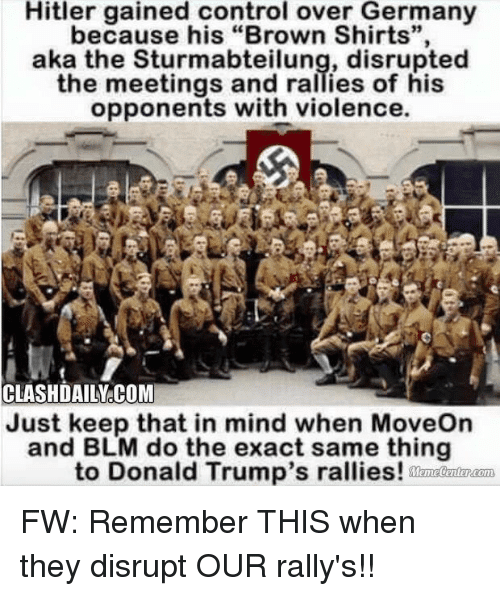 |
Just keep that in mind when Donald's supporters do the exact same thing to the Republican Party during the primaries and the convention. |

| That quote from Donald is verified by these news stories, all dated February 23, 2016. It's also verified by this YouTube video, which was uploaded by CNN on February 23, 2016. |
These are the first three paragraphs of a March 11, 2016 Los Angeles Times story. The links were in their story.
Donald Trump has said he'd like to "punch" protesters who flock to his rallies, and one of his supporters apparently took it upon himself to act.
Videos being circulated on social media Thursday showed a white man punching a black protester at a Trump rally in Fayetteville, N.C., on Wednesday.
According to the Cumberland County, N.C., sheriff's department, the suspect, John McGraw, was charged with assault and disorderly conduct in the assault on Rakeem Jones as Jones exited the rally. McGraw was scheduled to appear in court next month.
Sheriff's deputies detained Jones after he was punched. Jones was not charged with any crime and was only escorted out of the arena, said Sean Swain, a spokesman for the Cumberland County Sheriff's Office.
Donald's supporters are acting too much like Adolph's supporters did in the 1920s and the 1930s.
I fear for the safety of my country if he is elected, so I will exercise my legal and moral right to write the name "Ted Cruz" onto my ballot in November.
These three paragraphs are part of the obituary for Adolph Hitler that was published by the New York Times on May 2, 1945.
Those who had hoped that success at home and extension of his power abroad would make him more circumspect and reluctant to pursue the program of conquest he had outlined for himself in "Mein Kampf" and in his speeches had abandoned that hope when, in violation of his promise to respect the integrity of Czechoslovakia after Munich, he marched on Prague and reduced that nation to a German protectorate.
It was not the first promise he had broken. His whole course at home and abroad had been marked by broken promises and he did not hesitate to massacre many of his own closest adherents, as he did in the purge of June, 1934, when he personally directed the killing of Capt. Ernst Roehm and a group of leading Nazis who had ventured to interfere in his plans for a closer association of the Reichswehr with the regime and insisted upon fulfillment of the original Nazi party promises in the economic field.
The world-wide condemnation of his methods was fed by the system of terrorism he had established at home and in the countries he had conquered, the jailing of scores of thousands in prisons and concentration camps, the secret murder of opponents and those suspected of opposition, the ruthless destruction of the Jews and the persecution of the Catholic and Protestant Churches in his drive for nazification of the nation.
I put the caption on this photo myself, but the words are a paraphrase of words that he himself spoke.

More information about my reasons for voting for Senator Cruz are available in this May 2016 American Thinker article.
I wrote two long blog pages in early August 2016. They list, in detail, my reasons for not wanting to vote for Hillary and my reasons for not wanting to vote for Donald.
If you dig in the right place, you can find gold.
I can explain Mr. Trump's "blue-state appeal" very easily, because I have done something that Mr. Cohn, the writer of the previous article, has apparently not done. I have seen and analyzed a head-to-head poll of the choice that a voter could make in November.This is a link to a page on the Real Clear Politics website. The page shows the six most-recent national polls of a hypothetical contest between only two presidential candidates - Donald Trump and Hillary Clinton. The page also shows the average poll results, along with some information about the poll itself:
- the name of the polling organization (clickable link to that poll)
- the dates that the poll was taken
- the number of people who were sampled
- whether these people were likely voters or just registered voters
- the margin of error in the poll
Donald gives a clue to the real reason for his popularity among Democrats in this July 22, 2015 CNN article. These are the first four paragraphs.
Before Donald Trump was a front-running Republican presidential candidate, the real estate mogul believed that the nation's economy ran better when Democrats were in control and that Hillary Clinton would be a strong negotiator with foreign nations."If the current polls hold up,Trump would likely face Clinton in the general election."
"In many cases, I probably identify more as Democrat," Trump told CNN's Wolf Blitzer in a 2004 interview. "It just seems that the economy does better under the Democrats than the Republicans. Now, it shouldn't be that way. But if you go back, I mean it just seems that the economy does better under the Democrats. ...But certainly we had some very good economies under Democrats, as well as Republicans. But we've had some pretty bad disaster under the Republicans."
Trump still attacks plenty of Republicans today, but the comments praising Democrats are in stark contrast to the fiery rhetoric he deploys against them on the campaign trail, including President Barack Obama and Hillary Clinton.
If the current polls hold up,Trump would likely face Clinton in the general election. He considered her an appealing candidate for president when it came to dealing with foreign nations. In another interview with CNN's Blitzer in 2007, he praised her ability to negotiate when asked if she could successfully work out a deal with Iran.
... and he would lose to Hillary by more than 10% of the total popular vote, if the current Real Clear Politics poll average is an accurate predictor of the results of the general election in November.
If these poll results are accurate for each organization that has taken a poll, and if Real Clear Politics has accurately produced a moving average of the poll results for many different polling organizations, then I am now asking an important question.
Why are so many Democrats voting for Donald Trump in primary elections and caucuses?
Let's assume that the current polls are accurate.
It is an accepted principle in political science to make assumptions about candidates for the purpose of making campaign policies for the candidate that you are supporting. Every time a pollster asks a voter which of two candidates they would choose, the pollster is asking the voter to make a temporary assumption that these are the only two candidates who will be competing in November. The voter's ability to make an honest choice depends partly on his ability to make that assumption.I will now make another assumption. My assumption does more to explain Donald Trump's popularity among Democrats than Nate Cohn, the author of the New York Times article I quoted (and linked), who wrote, two days ago, that "... Mr. Trump’s blue-state appeal is a little hard to explain."
My assumption is that the Democrats who are voting for Donald Trump in the primary elections and caucuses are not "Reagan Democrats" who have been persuaded to vote for Donald by his rhetorical skill, his charisma, and his political organization.
The Democrats who are voting for Donald Trump are committed, hard-core Democrats. The reason why they are voting for Donald is because he is expected to lose to Hillary Clinton if they are the only two candidates in November.
These hard-core Democrats don't like the policies that Donald has advocated, but they have decided to vote for Donald so that other Republican candidates will lose to him during primary elections and caucuses, leaving him as "the last man standing" in November to face (and lose to) Hillary Clinton, who these hard-core Democrats want as a candidate.
To summarize: These hard-core Democrats are voting for Donald because Ted Cruz (or John Kasich) would be a stronger competitor to Hillary Clinton.
Democrat dreams
If these Democrats were asked to name their favorite presidential candidate in the Democratic Party, many of them would not choose Hillary Clinton, but many of the better Democrat Party candidates for President were voted out of office in the mid-term elections in 2014, which prevented many of these candidates from accumulating the political capital and the financial capital that they needed to run this year for president.Every presidential campaign begins at least two years early. Someone who is thinking of becoming a candidate ensures that he has a base of enthusiastic voters who will convince other people to vote for him. The potential candidate also makes friends with wealthy people and organizations who can make financial contributions to his campaign. All this must be done at least two years before the final election for president.
I'm writing this in late March 2016. Two years ago, Donald Trump didn't have the benefit of being elected to any public office, and he didn't have the benefit of receiving contributions from political action committees (PACs), but he had two adequate substitutes - he was the star of a popular television show, and he had accumulated some wealth through a long list of real-estate transactions.
Polls don't often lie.
Donald Trump, however, has one big disadvantage as a candidate. The Democrats who are voting for him now in primary elections and caucuses are hard-core Democrats. They care more about the core principles of the Democrat Party than they care about Mr. Trump.That means that when November comes, they will abandon Donald Trump and vote for the candidate that satisfies them more than Donald Trump.
These "crossover voters" will vote for Hillary Clinton.
These are the first two paragraphs of an April 25, 2016 Washington Examiner story.
Younger voters who have been the backbone of Sen. Bernie Sanders' campaign support, would easily shift to Hillary Rodham Clinton as the nominee and vote for her over Republican Donald Trump by a margin of 61 percent to 25 percent, according to Harvard University's latest Institute of Politics survey.
The poll released Monday shows that voters age 18-29 are expected to stick to their Democratic ways, preferring a generic Democrat in the White House 61 percent to 33 percent for a Republican, a huge blow to the GOP which expected to win over some millennials.
Earlier in this essay, I included a link to a March 25, 2016 article in the Washington Post. Charlotte Cavaille, the writer, attempted to show that Donald Trump's anti-illegal-immigrant rhetoric made him a similar candidate to some European politicians who have been winning elections there because of their own anti-illegal-immigrant rhetoric. The title of her article was, "No, Trump won't win votes from disaffected Democrats in the fall."
I agree with this prediction, but for a different reason. If (this is an assumption) Donald Trump is the nominee of the Republican Party, and if (another assumption) Hillary Clinton is the nominee of the Democrat Party, the Democrats will vote for a Democrat who says, loudly, that she believes in the principles of the Democrat Party, unlike the impostor Donald Trump.
"In many cases, I probably identify more as Democrat," Trump told CNN's Wolf Blitzer in a 2004 interview.
- quote from the July 22, 2015 CNN article that I quoted and linked earlier in this essay.
That's because Donald Trump is a Democrat.
Donald Trump tells it like it is
Sometime after Donald sent out this tweet, he deleted it, but @WEdwarda on Twitter saved it as a photo, so I copied it and pasted it here.
Someone on Twitter accused me during the week that ended April 2, 2016 of showing a fake Donald Trump tweet. This person said that Donald's Twitter account is a "verified" account and that all of his tweets are marked with a blue check mark.
That wasn't true in 2012, as this November 7, 2012 New Yorker article proves. The article reprints eight tweets that Donald made and later deleted. None of them includes the blue check mark.
Republican nightmares
This section was added June 1, 2016.Donald Trump is immature.
When he insults other Republicans, he is harming the Republican Party.
Whether he knows it or not, he is harming the Republican Party.
In all the years I taught junior high and high school no student even came close to Trump's juvenile name-calling. https://t.co/cPVW2ZN7xp— Sawsharee (@sawsharee) May 31, 2016
If he knows it, then that means that he is deliberately trying to hurt his own party. If Donald is trying to hurt his own party, then members of the Republican Party now have a reason to vote for someone else.
If he is unaware of the effect of his insults on loyal Republican voters, then he is out of touch with the best and most loyal members of his own party. These are the people who will volunteer for local candidates and donate money to them. They will even donate money to the treasury of the Republican National Committee.
These people are sometimes called the base of the party. Any presidential candidate must consider these people the most faithful, the most loyal, and the most valuable members of his party.
Any presidential candidate must love them, even if they voted for other candidates in primary elections. That is a sign of emotional maturity, something that Donald Trump doesn't have.
I wrote an article about my voting preferences and sent it to the American Thinker online magazine. They published my article, with minor changes, on Thursday, May 26.
Donald Trump is Hillary Clinton's favorite Republican
This section was added April 9, 2016.Pretend that you're Hillary Clinton's Campaign Manager and that it's the beginning of 2015, very early in the season for the 2016 presidential campaign.
A year ago, when there were more than 15 Republicans who were all trying to become president, in addition to the candidate that you're working for (Hillary Clinton), you decided, very rationally, that your candidate had a bad reputation for dishonesty and that she lacked a substantial achievement. She had been a lawyer for the Rose Law Firm, which misplaced legal documents (that can get you disbarred).
January 6, 1996 New York Times article.
June 2, 1996 Washington Post story "Hillary Clinton and the Whitewater controversy: A close-up"
an undated Frontline story on the website of the Public Broadcasting Service.
the Wikipedia entry for Whitewater Controversy.
March 4, 2015 Breitbart article. "Hillary Clinton's long history of hiding documents"
March 13, 2015 Daily Signal article "Hillary Clinton's career at Rose Law Firm [is] a bellweather for modern-day document destruction"
She had also been President Bill Clinton's wife (he was disbarred because the U.S. Supreme Court decided that he had lied to a Grand Jury.
These are the first four paragraphs of an October 1, 2001 Guardian (U.K.) article. Please note that in Great Britain, they spell a few words differently than we do in America.
The US supreme court yesterday issued an order disbarring former president Bill Clinton from practising law before the high court. The ruling is seen as marking the official end of the Monica Lewinsky scandal.This is a link to a similar story, also dated October 1, 2001, in the New York Times.
The ruling struck a jarring note in the current mood of national unity. Mr Clinton has been praised for the supportive role he has been playing and the way he has thrown his political weight behind President George Bush.
The court did not explain its reasons for the disbarment, although such a decision usually follows disbarment in a lower court. In April, Mr Clinton's Arkansas law licence was suspended for five years and he was given a $25,000 fine.
He had agreed to that disbarment as a form of plea bargain in January, on the day before he left office, after reaching a deal to bring an end to the Lewinsky investigation, in which he could have faced charges for contempt.
This is the link to the Wikipedia page for Clinton vs. Jones, which was ...
... a landmark United States Supreme Court case establishing that a sitting President of the United States has no immunity from civil law litigation against him or her, for acts done before taking office and unrelated to the office.All of the links in this paragraph were in their article.
Hillary's only achievement, as President Bill Clinton's wife, was to try to have Congress write her own version of a health-care law. The law was never passed by Congress. This March 1, 2014 Politico article documents their failure to pass a health-care law. According to the article, Republicans in Congress were able to win the political support of a large number of insurance companies in their effort to defeat Hillary.
Remember, you're still pretending that you're Hillary Clinton's Campaign Manager, that it's early in the U.S. campaign season (early 2015), and that Hillary has already earned some disrespect from the voters due to her record as a lawyer and as the wife of Bill Clinton. There is evidence of disrespect for your candidate in the private polling that every serious campaign manager does at the beginning of a campaign.
Hillary also has a weak record as a U.S. Senator from New York. She didn't have any memorable accomplishments, but she did take a strong stand in favor of Communism. This June 29, 2004 World Net Daily article documents the following quote.

Your candidate was also the U.S. Secretary of State for four years. These are two paragraphs from a December 8, 2013 Politico article. The link in the second paragraph (look for the word "said") was in their article.
All of which yields the question: Was Hillary Clinton in fact a good secretary of state, and will her record as a diplomat matter if, as expected, she runs for president in 2016?
As Bill Clinton might have said, it depends on what the meaning of good is. Certainly, even many of her most ardent defenders recognize Hillary Clinton had no signal accomplishment at the State Department to her name, no indelible peace sealed with her handshake, no war averted, no nuclear crisis defused. There are few Eric Schmidts out there still willing to make the case for her as an enormously consequential figure in the history of Foggy Bottom.
Read more: http://www.politico.com/magazine/story/2013/12/was-hillary-clinton-a-good-secretary-of-state-john-kerry-2016-100766#ixzz45LTD8Dhf
Follow us: @politico on Twitter | Politico on Facebook
For my international readers, "Foggy Bottom" is the colloquial name for the U.S. Department of State, which was headed by Hillary Clinton and is now headed by John Kerry.
What can you do, as Hillary's Campaign Manager, to improve her chances of winning the 2016 election when it's early in 2015?
That's an easy decision. You have a very private talk with one of your best friends, who is a successful businessman named Donald Trump. You ask him to support your campaign with a financial donation (which he does) and you also ask him to run for President as a Republican, so that he can eliminate other Republican candidates who would be tough opponents against your own candidate (Hillary Clinton).
Donald Trump insults people, including known Republicans
| ... often because of their looks ... ... but he rarely insults Democrats for any reason. For 3½ minutes, watch him insult journalists, beauty contest contestants, and a female presidential candidate personally. |
Lindsey Graham urged Republicans to rescind endorsements of Trump, citing remarks on judges https://t.co/5VkIy5WH0d pic.twitter.com/SCOhy8lSaF— The New York Times (@nytimes) June 7, 2016
Donald Trump celebrates a special occasion with his friends
This is Donald and his wife Melania, in formal wear, celebrating a special occasion with two of their best friends. He could very well be celebrating her expected victory over a very friendly rival, one who hasn't spent much time discussing the traditional Republican values of small unobtrusive government, low taxes, a strong U.S. military, a large middle class (composed of small-business owners and employees of large corporations), and stable marriages.
So what can a Ted Cruz supporter do?
I am a supporter of U.S. Senator Ted Cruz. He has consistently supported many of the same conservative ideas that I support, including- reverence for the United States Constitution, including all of its' amendments
- the Federalist system of government (political power is shared among three co-equal governmental branches at the Federal level and at the state level, with other power remaining in the hands of the people)
- reverence for traditional institutions, including traditional marriage (especially his own traditional and long-lasting marriage)
- respect for those who are willing to fight and die to preserve liberty
- acceptance of the role of a politician as a public servant
I recommend that the supporters of Ted Cruz do exactly what I'm doing - campaigning for him in a positive way (I retweet many of the messages from his most enthusiastic supporters) and campaigning against Mr. Trump by pointing out his flaws, which is exactly what I am doing with this essay,.
Donald Trump is a Democrat. If he is the Republican nominee, he will lose to Hillary in November, so in order for the Republican nominee to win in November, Ted Cruz must be the Republican nominee.
It's that simple. Vote for Ted Cruz in every primary election and caucus, and when November comes, vote for Ted Cruz again.
Updates
January 20, 2018
This tweet was posted on the day before the one-year anniversary of the swearing-in of President Donald Trump, who I often call "The Dirtbag". I usually add a hashtag symbol "#" so that my Twitter readers can find other tweets with that same insult.NEW: Immigrants entering the United States illegally through the southern border are quietly being relocated to different parts of the country on commercial flights, high-ranking Homeland Security officials told Judicial Watch this week.https://t.co/Ip9pI0SGFe— Judicial Watch 🔎 (@JudicialWatch) January 20, 2018
 This is the same illegal process that Bam-Bam Obama used to send the illegals in the wrong direction (into the country instead of out of it).
The only difference is that Bam-Bam used DHS buses instead of airplanes.


