Tuesday, January 31, 2017

California secession


The word secession is a noun.  When a part of a country leaves that country and becomes a separate and independent country, that is a seccession.


A group of states in the United States tried to secede from the United States in the 1860s.  This action caused a war to be fought, with rifles, cannons, and armed ships on both sides.

More Americans died during this war, called The Civil War, than during both of the world wars combined.

This paragraph is on the F.A.Q. page of the website Civil War Trust.  All of the links were on their page.
Q. When was the Civil War fought?
The war began when the Confederates bombarded Union soldiers at Fort Sumter, South Carolina on April 12, 1861.  The war ended in Spring, 1865.   Robert E. Lee surrendered the last major Confederate army to Ulysses S. Grant at Appomattox Courthouse on April 9, 1865.  The last battle was fought at Palmito Ranch, Texas, on May 13, 1865.
Link to the Google account for +Civil War Trust

These two paragraphs were on the same page.  Both of the links in the first paragraph were on their page.
Q. How many soldiers died in the Civil War?
Approximately 620,000 soldiers died from combat, accident, starvation, and disease during the Civil War.  This number comes from an 1889 study of the war performed by William F. Fox and Thomas Leonard Livermore.  Both men fought for the Union.  Their estimate is derived from an exhaustive study of the combat and casualty records generated by the armies over five years of fighting.  A recent study puts the number of dead as high as 850,000.

Q. How many soldiers died in the Civil War as compared to other American wars?
Roughly 1,264,000 American soldiers have died in the nation's wars--620,000 in the Civil War and 644,000 in all other conflicts.  It was only as recently as the Vietnam War that the amount of American deaths in foreign wars eclipsed the number who died in the Civil War.


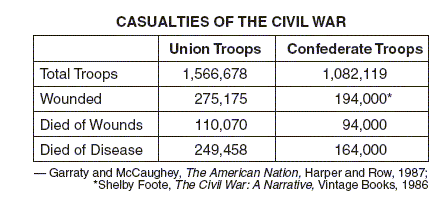
This graphic with statistics about the dead and wounded troops came from this web page.
Near the end of this war, President Abraham Lincoln, a faithful Christian, tried to heal the wounds of the war by burying Northern and Southern soldiers who had fought and died in the same battle in a new cemetery.

The President was personally present to dedicate this cemetery, and he spoke the words that are carved into the stone of his memorial, located in Washington, D.C.

This speech is called the Gettysburg Address. +Gettysburg 150th


News stories about the proposed California secession

These stories are arranged in chronological order, oldest first.

These are the first two paragraphs of a July 15, 2014 Washington Post story.  The graphic was included in the story.  All of the links in these paragraphs were also included in the story.  +Washington Post
Proponents of a ballot initiative aimed at splitting California into six states (or, more simply, one proponent: venture capitalist Tim Draper) may have collected enough signatures to put the initiative on the ballot.  This is the beauty and the annoyance of California's initiative and referenda system.  If you have enough cash, getting something on the ballot is relatively trivial, meaning that relatively trivial ideas -- like splitting California into six different states -- can be put up for a vote.  (Happily, in this instance the federal government would have to sign off on the idea, which it will never do, because, come on.)

Draper's proposal is that California become six different states, each with its own capital and senators and so on.  That's really one of the main selling points:  Why should the millions of people in California have the same number of senators as the hundreds of thousands of people in Wyoming?  And the answer is: Because you get to live by the coast and the redwoods and the beautiful people of Los Angeles and that is the price you pay.  Everyone knows that.

These are the first four paragraphs of a November 21, 2016 story in the Sacramento Bee.
“Should California become a free, sovereign, and independent country?”

The question could appear on a statewide ballot in 2018 if a group of secessionists has its way.

Yes California has been pushing for the state to break away from the United States and become its own country for several years.

Marcus Evans, the vice president of Yes California, filed a proposed ballot measure with the Attorney General’s Office on Monday that would appear on the November 2018 gubernatorial ballot.
The preceeding story from +The Sacramento Bee is a balanced story.  It includes a contrary opinion from a professor of law at the Berkeley campus of the University of California.  I copied and pasted his quoted remarks onto a later portion of this page.


Link to a story dated the next day in the Los Angeles Daily News.  This story is not balanced.  It doesn't include any reference to previous attempts to secede, and it doesn't include any mention of the low probability of success.


These are the first five paragraphs of a January 26, 2017 Fox News story.
A proposal for California to secede from the United States was submitted to the Secretary of State’s Office Thursday.

The proposed “Calexit” initiative - its name borrowed from the UK's "Brexit" departure from the EU - would ask voters to repeal part of the state constitution that declares California an inseparable part of the U.S.

A recent poll found that one in three California residents would support a possible secession from the U.S. due to their opposition to President Trump. No mention has been made of the president in the proposal.

If the proposal qualifies for the ballot and is approved by voters, it could be a step to a future vote on whether the state would break away from the rest of the nation.

Secretary of State Alex Padilla said the group behind the proposal, Yes California Independence Campaign, was cleared to begin attempting to collect nearly 600,000 voter signatures needed to place the plan on the ballot.
This is how the fourth paragraph of the +Fox News story begins.

"If the proposal qualifies for the ballot and is approved by voters ...."

Link to a similar story on the website of the Los Angeles Times, dated the same day.  This +Los Angeles Times story was linked at the end of a four-paragraph story on the website of Los Angeles television story KTLA.  Link to the Google account for +KTLA 5

Link to a similar story on the website of National Public Radio dated the next day, January 27, 2017.  Link to the Google account for +NPR and +NPR Politics

This is the complete text of an Associated Press story that was published in U.S. News and World Report on July 25, 2017.
SACRAMENTO, Calif. (AP) — A group that wants California to secede from the United States can start collecting signatures for its ballot initiative.

The state attorney general issued an official ballot measure title and summary Tuesday.  The campaign can now start gathering the more than 585,000 signatures it will need to qualify for the 2018 ballot.

The initiative would form a commission to recommend avenues for California to pursue its independence and delete part of the state constitution that says it is an inseparable part of the U.S.  The measure would also instruct the governor and California congressional delegation to negotiate more autonomy for the state.

This is the second attempt to put a so-called Calexit measure on the 2018 ballot.  An earlier attempt was withdrawn in April.
This is the last paragraph.

"This is the second attempt to put a so-called Calexit measure on the 2018 ballot.  An earlier attempt was withdrawn in April."


Stories about international secessionist movements

Link to a June 27, 2016 story in The Guardian about the vote by people in England to leave the European Union.  This page tells, in detail, how people in different parts of England voted.  Link to the Google account for +The Guardian


These are the first three paragraphs of this November 10, 2016 Associated Press story.  The entire story is only five paragraphs.  Link to the Google account for +The Associated Press
JOHANNESBURG (AP) — Portuguese rule in Angola ended in 1975, but separatists in one Angolan province want the former colonizers to return.

The Portuguese news agency Lusa reported Thursday that a separatist group in Angola's oil-rich Cabinda province wants Portugal to oversee a referendum there on the region's political future.

Militants of the Front for the Liberation of the Enclave of Cabinda have carried out kidnappings and other attacks over the years.  They say the Cabinda enclave was never part of Angolan territory.

This January 24, 2017 page on the website of the British Broadcasting Corporation, explains what it means, in simple terms, for England to leave the European Union.  The English people voted to do that on June 23, 2016.


Other efforts to secede from the United States

These articles are arranged in chronological order, oldest first.

Armed members of the Republic of Texas separatist group took hostages in 1997.
This November 14, 2012 Politico story says that America's first secession movement came from five of the six New England states.  According to this link to an Encyclopedia Britannica article that was included in their story, they were Federalists
... who were dissatisfied with Pres. James Madison’s mercantile policies and the progress of the War of 1812 (“Mr. Madison’s War”), as well as long resentful over the balance of political power that gave the South, particularly Virginia, effective control of the national government.
All three of the links in the previous paragraph were in the Encyclopedia Britannica article.

This September 17, 2014 story in the San Antonio Express-News is about a group that wants to have Texas secede from the rest of the country.

These are the first three paragraphs of a February 23, 2015 Houston Chronicle story.
It seemed like a typical congressional meeting for the Republic of Texas.  Senators and the president gathered in the center of a Bryan, Texas, meeting hall, surrounded by public onlookers, to debate issues of the national currency, develop international relations and celebrate the birthday of one of their oldest members.

But this wasn't 1836, and this would be no ordinary legislative conference.  Minutes into the meeting a man among the onlookers stood and moved to open the hall door, letting in an armed and armored force of the Bryan Police Department, the Brazos County Sheriff's Office, the Kerr County Sheriff's Office, Agents of the Texas District Attorney, the Texas Rangers and the FBI.

In the end, at least 20 officers corralled, searched and fingerprinted all 60 meeting attendees, before seizing all cellphones and recording equipment in a Valentine's Day 2015 raid on the Texas separatist group
When uniformed and armed members of law enforcement prevent people from recording their activities, they're not enforcing the law any more.  They're making their own laws, in the true spirit of a dictatorship, which is always bad news for its' own people.

This paragraph is on this undated web page of the International Association of Chiefs of Police.
The International Association of Chiefs of Police (IACP), with funding from the Office of Community Oriented Policing Services (COPS), is developing a training toolkit addressing the public’s right to record police officers.  This training focuses on the public’s First Amendment right to record, limitations of this right, common police responses to recording individuals, strategies for diffusing and deflecting police-civilian confrontations, and how and when video equipment or recordings can be seized.  This toolkit, expected to be released in late 2016, will include an Instructor’s Guide, Officer Study Guide, PowerPoint Presentation, and Training Video.
This undated page on the website of The Texas Nationalist Movement explains why they want to secede.  I hope that the Texas Nationalist Movement is not as violent as the Republic of Texas group. +San Antonio Express-News

The Texas Nationalist group failed to have a committee of the Texas Republican Party approve, by a vote, their wish to have Texas secede from the Union.  Link to a May 13, 2016 Washington Post story.

A dissenting opinion from a professor of law

The November 21, 2016 story in the Sacramento Bee that I quoted earlier on this page also included these four paragraphs.  Both of the links in these paragraphs were in their story.
Daniel Farber is a law professor at U.C. Berkeley and has written about secessionist movements throughout America’s history.

Yes California’s plan to appeal to the United Nations wouldn’t hold up in court, he said.  Other countries might hesitate to embrace California as an independent nation anyway, particularly if issues of currency and military were not negotiated with the remainder of the country first.  Other nations likely wouldn’t want to “risk the blowback of being on the losing side,” he said.

The only legal avenue for California to secede requires the state to win approval by two-thirds of Congress and three-quarters of the states in the country, he said.  Farber pointed to a Supreme Court decision, Texas vs. White, in 1869 that said Texas “entered into an indissoluble relation” when it became part of the United States.  The case related to bonds sold by Texas during the Civil War.

“I don’t think it gets to the point where we have to worry about those details and how to make it work,” Farber said.  “Many of us have had that thought from time to time, but in the end it’s not really a feasible option as far as I can see.”
"The case related to bonds sold by Texas during the Civil War."

What goes around, comes around.

Professor Farber mentioned a method that could allow the State of California to secede.  He called it "the only legal avenue", and he mentioned a legal case that the U.S. Supreme Court decided in 1869, after the end of the Civil War.  This is a link to that case.

The method would require an amendment to the U.S. Constitution.  There are two methods of proposing amendments but only one way to ratify them.  Both processes are explained in Article 5 of the Constitution.  This page, on the website of the U..S. Government agency that preserves government documents, explains the process.

This June 27, 2016 Washington Post story shows a four-step process and the odds of anyone reaching those goals.

An article published in National Review, January 29, 2017 has a very different idea, judging by the title of the article, California Shouldn’t Secede from the U.S. subtitled "It should divide in two."

The article by the +National Review advocates for a handful of coastal counties to be one state, with the rest of California being a different state.  The article includes this map of their concept.


My opinions

If the Yes California activists have their way, California will become a separate and sovereign nation, with its' own government and the legal power to establish its' own "national defense", using its' own military.  The new country called California will, of course, need to prepare to defend its' borders as a nation with potentially hostile neighbors.  This is what their border with Nevada could look like.


This is the 21st century, so the new nation would have to use more modern weapons, including chemical and biological poisons.  The video and photo below shows these weapons successfully being used in Iraq.
The video was uploaded in 2013.
So what if a few children die.  National sovereignty is more important, right, +Calexit - YesCalifornia?


The Yes California organization is studying these weapons so that they can decide how to use them effectively.  The actual implementation would, of course, have to be done by trained soldiers of the California State Police, who would become the new national army of California.

The California State Legislature has already taken many actions that are different than the attitudes of the rest of the nation.  For example, State legislation, formally called Proposition 60, was on the ballot in California on the same day when the nation voted to elect Donald Trump as President.  This legislation would have forced male actors in adult films to wear a condom while they were doing their job (having sex with an actress in adult films.  I wrote about this issue in this August 2014 blog essay, which was updated last November to show the result of the vote on Proposition 60.

Another example is a new state law that decriminalizes child prostitution.  These are the first three paragraphs of a January 4, 2017 op-ed in the Washington Times.
At the start of each new year we’re subjected to a whole host of new laws.  The modern liberal government, you see, imagines itself not as the champion of individual freedom but as Mommy and Daddy, a taskmaster charged with controlling your life.  Most of the time, it makes everything, including our lives, worse.

Case in point: California. Completely at the mercy of the left, which now controls two-thirds of the state government, California serves as a living illustration of what the left really wants to accomplish.  As of Jan. 1, that includes decriminalizing what is commonly called “child prostitution.”

They may not have technically legalized it, but decriminalizing the act per se will have the same results, while putting exploited children in even more danger.


Every group that wants to separate from its' home country is a threat to the safety and the security of that country, however some separations are justified by the oppression of the group by the political leaders of the home country.

The following words in the Declaration of Independence are a harsh accusation of the abuse of a group of British colonies by the British King.  This accusation is an explicit one, with examples of the tyranny that they have suffered.

"The history of the present King of Great Britain is a history of repeated injuries and usurpations, all having in direct object the establishment of an absolute Tyranny over these States."

In the 1860s, a large number of the people in our southern states felt that the government in Washington was behaving tyrannically.  One of them even assassinated President Lincoln and then immediately jumped from a theater balcony to the theater stage.  He shouted the Latin phrase Sic semper tyrannis.  The English-language translation is "Thus always to tyrants".

During the years that preceded the American Revolution, a few people published their reasons for wanting to have a separate country.  These people included Benjamin Franklin.  I named my Twitter account @BennyTheKite in his honor.


Another man who published and distributed reasons to leave Great Britain was Thomas Paine.


Let the people in California who want to leave the United States publish their reasons for wanting to leave.

If their cause is just and if they are willing to fight for it, they will win their independence, but they will pay a price for it, and none of them will be able to wear the symbol on the right very proudly. +Peace Corps


Dated updates

The dates you see in the headlines are the dates that I posted the articles.

May 21, 2017

This is a link to a March 1, 2017 Atlantic Monthly article titled, Is Russia Behind a Secession Effort in California?.

Their article was accurate.  These are the first four paragraphs of an April 18, 2017 Fox News story.
The man behind the Calexit movement, which pushed for California to secede from the union, is now distancing himself from the controversial effort and said he will stay in Russia.

Louis Marinelli, who helped launch the movement to make California an independent state, said that he “intends to make Russia” his “new home.” As a result, he is withdrawing his petition for a “Calexit” referendum.

Marinelli has said in the past that in Russia he has found, “a new happiness, a life without the albatross of frustration and resentment towards ones’ homeland.”

The activist said in a statement he does not intend to return to California in the foreseeable future and therefore feels it’s only right for him to withdraw the Calexit petition.
Link to a similar article, dated the same day, in the New York Magazine.


August 15, 2017

These are the first five paragraphs of a July 25, 2017 Los Angeles Times story.  All of the links in these paragraphs were in their story.
Supporters of a plan for California to become independent from the United States are now allowed to gather signatures for their ballot measure.

On Tuesday afternoon, Atty. Gen. Xavier Becerra's office released an official title and summary for the initiative, now called the "California Autonomy From Federal Government" initiative.

The proposal, scaled back from an initially more aggressive version, would direct California's governor to negotiate more autonomy from the federal government, including potentially putting forward a ballot measure to declare independence.

The initiative wouldn't necessarily result in California exiting the country, but could allow the state to be a “fully functioning sovereign and autonomous nation” within the U.S.

Backers of the plan, known informally as "Calexit" have 180 days to collect nearly 600,000 valid signatures for the initiative to go on the 2018 ballot.
Link to a similar story, dated the same day, written by the Associated Press and published on the website of U.S. News and World Report.

Link to a similar story, dated the next day, and published by Breitbart.


August 1, 2018

These are the first three paragraphs of a July 31, 2018 Fox News story.  The graphic and caption were included in their story.  Both of the links in these paragraphs were also in their story.

California secessionists plan to retool their movement this week to include a large-scale land giveaway to Native Americans. (Calexit founder Louis J. Marinelli)
Organizers of a long-running initiative to secure California’s secession from the United States now say they want to give away nearly half of the state, including all of its federal land, to form an “autonomous Native American nation.”

“Calexit,” as the proposal for California’s secession is known, was given the green light by the state government earlier this year to begin collecting signatures to place the measure on the November ballot.  Advocates had until mid-October to gather 365,880 signatures of registered voters to put it up for a statewide vote.

But the revamp announced by Calexit’s founders on Tuesday adds an additional objective: constructing “the first ever autonomous Native American nation in North America,” by giving Native Americans all federal lands in the state, running from the border with Mexico to the state boundary shared with Oregon.
This August 1, 2018 Daily Mail (U.K.) story linked to the Fox News story.

These are the first paragraphs of a June 3, 2024 CalMatters article.

These are the first paragraphs of a press release that was issued by the California Secretary of State on January 23, 2025.

These are the first paragraphs of a January 24, 2025 USA Today story.

End

Thursday, September 15, 2016

The U.S. House may choose the U.S. President


A procedure that has been in the U.S. Constitution since 1804 and only used once since then is likely to be used this year, due to a special set of circumstances that very rarely shows up in American politics.

Because this procedure is in the Constitution, it cannot be voided by any law that is passed by Congress.  Any such law, called a statute, that conflicts with the Constitution, in the opinion of the U.S. Supreme Court, is itself voided.

The only legal way to void or nullify an amendment to the Constitution is to add another amendment.  The 21st Amendment explicitly nullified the 18th Amendment.  Link to a page on the History Channel website about these two amendments.

Part of the following amendment has been voided, as mentioned below, with documentation, but every other sentence in this amendment is still valid.


The 12th Amendment to the Constitution

I copied the text from this page on the website of a U.S. Government agency called the National Archives.  This agency has many historical documents, including a 1790 petition that Benjamin Franklin mailed to Congress, asking them to abolish slavery, an 1866 petition for universal suffrage (voting rights for every American man and woman), and 1941 legislation that established Thanksgiving as a national holiday.

The website of the National Archives says that this amendment superceded part of Article II, Section 1 of the Constitution.  That means that part of Article II, Section 1 has been voided and is no longer a valid part of the U.S. legal system.

When the 12th amendment was passed, it was in the form of one very long paragraph.  I'm going to divide it up into three parts because some of the sentences in this amendment were voided by part of the 20th Amendment.

On this blog page, I have referred to the voided part of this amendment as "Part 2" of this amendment.  Every other sentence in this amendment, which I refer to as "Part 1" and "Part 3" is still legally valid as a fully-ratified and functional amendment to the U.S. Constitution.


Part 1

The Electors shall meet in their respective states and vote by ballot for President and Vice-President, one of whom, at least, shall not be an inhabitant of the same state with themselves; they shall name in their ballots the person voted for as President, and in distinct ballots the person voted for as Vice-President, and they shall make distinct lists of all persons voted for as President, and of all persons voted for as Vice-President, and of the number of votes for each, which lists they shall sign and certify, and transmit sealed to the seat of the government of the United States, directed to the President of the Senate; -- the President of the Senate shall, in the presence of the Senate and House of Representatives, open all the certificates and the votes shall then be counted; -- The person having the greatest number of votes for President, shall be the President, if such number be a majority of the whole number of Electors appointed; and if no person have such majority, then from the persons having the highest numbers not exceeding three on the list of those voted for as President, the House of Representatives shall choose immediately, by ballot, the President. But in choosing the President, the votes shall be taken by states, the representation from each state having one vote; a quorum for this purpose shall consist of a member or members from two-thirds of the states, and a majority of all the states shall be necessary to a choice.


Part 2 (superceded by Section 3 of the 20th Amendment)

And if the House of Representatives shall not choose a President whenever the right of choice shall devolve upon them, before the fourth day of March next following, then the Vice-President shall act as President, as in case of the death or other constitutional disability of the President.


Part 3

The person having the greatest number of votes as Vice-President, shall be the Vice-President, if such number be a majority of the whole number of Electors appointed, and if no person have a majority, then from the two highest numbers on the list, the Senate shall choose the Vice-President; a quorum for the purpose shall consist of two-thirds of the whole number of Senators, and a majority of the whole number shall be necessary to a choice. But no person constitutionally ineligible to the office of President shall be eligible to that of Vice-President of the United States.


Grammatical analysis of the relevant Text

Most of Part 1 of the text of the 12th Amendment describes the operation of the Electoral College, including this sentence.  "the President of the Senate shall, in the presence of the Senate and House of Representatives, open all the certificates and the votes shall then be counted;"

The next sentence, however, is grammatically complex.  Here it is.

"The person having the greatest number of votes for President, shall be the President, if such number be a majority of the whole number of Electors appointed; and if no person have such majority, then from the persons having the highest numbers not exceeding three on the list of those voted for as President, the House of Representatives shall choose immediately, by ballot, the President."

There are two main clauses in this sentence, and both of them are in the form of an if-then statement.  An if-then statement allows for an action to be taken if a certain condition is met.  The two main clauses differ from each other.  One specifies a procedure that will be followed if one presidential candidate receives a majority of all of the votes of the appointed Electors (members of the Electoral College).  The other clause specifies a procedure that will be followed if none of the presidential candidates receives a majority of those votes.

This is the text of that second clause, copied directly from the amendment.

"... and if no person have such majority, then from the persons having the highest numbers not exceeding three on the list of those voted for as President, the House of Representatives shall choose immediately, by ballot, the President."

If no person have such majority,

then from the persons having the highest numbers not exceeding three on the list of those voted for as President, the House of Representatives shall choose immediately, by ballot, the President.

The conditional action is that the U.S. House will choose the president.  The condition that allows this to happen is none of the presidential candidates having a majority of the votes of the Electoral College.

There are three further restrictions on the voting by the House.  They can only consider the three candidates who received the most number of popular votes, and they must vote by ballot.  They cannot announce their vote by speaking their choices or by raising their hands, and they must vote immediately.  They are not allowed to begin a campaign for their favorite candidate that will take weeks or months to complete.

That second if-then clause is very interesting, because it was followed during one election in U.S history, and I believe that this special procedure will be followed again this year.

That second clause is also interesting because the polling that is being done that includes the top four presidential candidates shows that none of them is close to having a majority.  A website called Real Clear Politics mentions these polls.  The results of this four-person polling is explained later on this page.


The Electoral College

Early history

It was established by Article II, Section 1 of the Constitution and modified by the 12th Amendment.  When the 20th Amendment was ratified, it modified how this "institution" operates even further, but the institution itself still functions, with a slightly modified operation.

These are the first four paragraphs of another page on the website of the National Archives.  All of the links in these paragraphs were on their page.
The Electoral College is a process, not a place.  The founding fathers established it in the Constitution as a compromise between election of the President by a vote in Congress and election of the President by a popular vote of qualified citizens.

The Electoral College process consists of the selection of the electors, the meeting of the electors where they vote for President and Vice President, and the counting of the electoral votes by Congress.

The Electoral College consists of 538 electors.  A majority of 270 electoral votes is required to elect the President.  Your state’s entitled allotment of electors equals the number of members in its Congressional delegation: one for each member in the House of Representatives plus two for your Senators.  Read more about the allocation of electoral votes.

Under the 23rd Amendment of the Constitution, the District of Columbia is allocated 3 electors and treated like a state for purposes of the Electoral College. For this reason, in the following discussion, the word “state” also refers to the District of Columbia.
This is the first sentence in the third paragraph.  "The Electoral College consists of 538 electors."

These are the first two paragraphs of Article II, Section 1 of the Constitution.  These words have not been voided or modified by any amendment.
The executive Power shall be vested in a President of the United States of America.  He shall hold his Office during the Term of four Years, and, together with the Vice President, chosen for the same Term, be elected, as follows

Each State shall appoint, in such Manner as the Legislature thereof may direct, a Number of Electors, equal to the whole Number of Senators and Representatives to which the State may be entitled in the Congress: but no Senator or Representative, or Person holding an Office of Trust or Profit under the United States, shall be appointed an Elector.
The 10th Amendment states that
The powers not delegated to the United States by the Constitution, nor prohibited by it to the States, are reserved to the States respectively, or to the people.
In this case, however, it was not necessary to give a power to the states by default.  Article II, Section 1 explicitly said that the states have the power to choose their own electors, and there are only two limits on their power.  This section determines how many electors there are, and it states that Electors cannot be a current Senator or Representative, or any other person holding an office of trust or profit.  Any other person can be chosen by a state to be someone who casts a direct vote for the President of the United States.

The Electors

There are currently 438 members of the U.S. House of Representatives and 100 U.S. Senators, not counting vacancies.  This page on the website of the Clerk of the House of Representatives shows the vacancies in the House.

The number of the Electors has gone up along with the number of the people who are members of the U.S. House of Representatives, but no matter how many people there are in the Electoral College, the Constitution requires that the President must be the person who has at least half of their votes.

During almost all of the previous elections in this country, one presidential candidate had a majority of the votes in the Electoral College.  A majority is half of the total, plus one if the number of members is an even number.  Half of 538 is 269. but 538 is an even number, so a majority of that group would be 270.

This is a link to a similar page on the website How Stuff Works.

This is a link to a similar page on the Wikipedia website.

This is the Electoral College page on the History Channel website.

The electors only perform one function, and they only do this once every four years.  They vote directly for a combination of a President and a Vice-President.  Their vote determines which combination will have all the executive power of the White House and all of the military power of the United States Commander-in-Chief.  Most of the time, one candidate duo will have a majority of their votes, but if none of the presidential candidates have a majority of their votes, then under the terms of the 12th Amendment, the official members of the U.S. House of Representatives will make an immediate vote, without any time for campaigning.

The immediate vote process was explained earlier in the section about the 12th Amendment.


The 20th Amendment

This amendment was passed by Congress in March 1932 and was ratified by the states in January 1933, according to this page on the website of the National Constitution Center.  It has six sections.  The third section, whose text is on the page linked above, does modify what I refer to as "Part 2" of the 12th Amendment, but not "Part 1", which includes the process for choosing a president if none of the candidates has a majority of the Electoral College votes.

Link to the 20th Amendment on the website of
The Annenberg Classroom The Legal Information Institute
Totally History Wikipedia

As I said earlier, one election very early in American history followed the special procedure in the 12th Amendment that allows for the president to be chosen by a vote of the members of the U.S. House.


The 1824 election

In all of America's history, this second clause was used only once, because only one American presidential election (up until now) featured candidates who were close competitors to each other on Election Day.  These are the first three paragraphs of this page on the History Channel website.
As no presidential candidate received a majority of electoral votes in the election of 1824, the U.S. House of Representatives votes to elect John Quincy Adams, who won fewer votes than Andrew Jackson in the popular election, as president of the United States.  Adams was the son of John Adams, the second president of the United States.

In the 1824 election, 131 electoral votes, just over half of the 261 total, were necessary to elect a candidate president.  Although it had no bearing on the outcome of the election, popular votes were counted for the first time in this election.  On December 1, 1824, the results were announced.  Andrew Jackson of Tennessee won 99 electoral and 153,544 popular votes; John Quincy Adams of Massachusetts received 84 electoral and 108,740 popular votes; Secretary of State William H. Crawford, who had suffered a stroke before the election, received 41 electoral votes; and Representative Henry Clay of Kentucky won 37 electoral votes.

As dictated by the U.S. Constitution, the presidential election was then turned over to the House of Representatives.  The 12th Amendment states that if no electoral majority is won, only the three candidates who receive the most popular votes will be considered in the House.
This is the last sentence of the third paragraph of the History Channel page.

"The 12th Amendment states that if no electoral majority is won, only the three candidates who receive the most popular votes will be considered in the House."

This is another copy of the text of that second clause in the 12th Amendment.

"... and if no person have such majority, then from the persons having the highest numbers not exceeding three on the list of those voted for as President, the House of Representatives shall choose immediately, by ballot, the President."

In 1824, the U.S. House of Representatives chose the person with the 2nd highest number of Electoral College votes, John Quincy Adams.


The electoral results in 1824

These are the electoral votes that were recorded in 1824 and the first two sentences of the second paragraph of the History Channel website.
Andrew Jackson 99
John Quincy Adams 84
William H. Crawford 41
Henry Clay 37
"In the 1824 election, 131 electoral votes, just over half of the 261 total, were necessary to elect a candidate president.

Although it had no bearing on the outcome of the election, popular votes were counted for the first time in this election."
In 1824, there were 261 people in the Electoral College.  That number is now 538.

As you can see, none of the four candidates received the necessary 131 electoral votes to be President under the conditions of the first clause of this amendment.  The candidate who had the most votes didn't even get 100 votes, but 131 votes were necessary because that was "half-plus-one" of the total votes in the Electoral College.

Here is the text of the first clause of that very important sentence in the 12th Amendment.

"The person having the greatest number of votes for President, shall be the President, if such number be a majority of the whole number of Electors appointed ...."

The 1824 election had four presidential candidates.  None of them had a majority of the votes in the Electoral College.  131 votes was a majority in that year, but the person who had the most Electoral College votes only got 99 Electoral College votes.

The reason why none of the presidential candidates received a majority of the Electoral College votes is interesting to historians.  I will summarize the history of that election by saying that all four of these men were close competitors to each other.

It is also interesting to note that Andrew Jackson, the candidate who got the most Electoral College votes the first time they voted, was not the ultimate winner that year.  During the voting by members of the U.S. House, they chose the 2nd place finisher, John Quincy Adams, to be the President.


This is the web page for President John Quincy Adams on the White House's website.


Summary of the 12th Amendment

It is the process that officially chooses the U.S. President.  Part of this process is a vote by the U.S. House of Representatives to select a president if a certain condition is met.  That condition is a lack of a majority vote by any of the presidential candidates, which can be thought of as a lack of support for any one presidential candidate over another presidential candidate.


The 2016 election

The current poll results

In 2016, Hillary Clinton and Donald Trump are also close competitors to each other, but they are not the only candidates who will be on ballots in November.

These two sentences are on the 2016 Presidential Candidates page of the Ballotpedia website.  All of the links, including the clickable footnote, were on their page.
As of August 15, 2016, a total of 1,840 candidates had filed a Statement of Candidacy with the Federal Election Commission.[1]  A full list of these candidates and their parties and filing dates can be found here.
The top of this page mentions four major party candidates, Donald Trump, Hillary Clinton, Jill Stein, and Gary Johnson.  Remember, there were four candidates in 1824 also.

These are the first two paragraphs of an August 26, 2016 NewsMax article.  The link was in their article.
Donald Trump and Hillary Clinton are in a virtual tie, according to the USC Dornsife/LA Times tracking poll.

Trump owns the slight edge over Clinton: 44.3 percent to 43.6 percent.
As of late August, less than one percentage point separated the Republican nominee from the Democrat nominee in this "tracking poll", which samples the same group of 3,000 eligible voters over a long time period.

These are the first two paragraphs of an August 28, 2016 Morning Consult article.
Donald Trump trails Democratic rival Hillary Clinton by only 3 percentage points in a new national poll from Morning Consult, shrinking a deficit that has alarmed GOP operatives who fear their unconventional nominee may harm the prospects of other Republican candidates on the ballot this fall.

In a survey taken Aug. 24 through Aug. 26, Trump halved the 6-point distance between himself and Clinton from the previous week’s poll.  In the most recent head-to-head matchup, 43 percent of registered voters say they will vote for Clinton, and 40 percent say they will vote for Trump; 17 percent don’t know or have no opinion.
This is the second sentence of the second paragraph

"In the most recent head-to-head matchup, 43 percent of registered voters say they will vote for Clinton, and 40 percent say they will vote for Trump; 17 percent don’t know or have no opinion."

I don't believe this writer.  I think that third group of voters, 17% of the total, who are described by the writer as "don't know or have no opinion", do have an opinion which the writer does not wish to mention.  Their opinion is that they don't like Hillary or Donald and will instead vote for Gary Johnson, Jill Stein, Evan McMullin, or someone else.

The Real Clear Politics website includes a page that shows the average of several recent polls that included the names of four candidates,, specifically the four candidates who are likely to receive the most votes.  Their page shows
  • the dates that the polling was performed,
  • the name of the organization that conducted the poll,
  • how many voters were sampled,
  • whether these were "likely" voters or "registered" voters, and
  • the votes for each of the four candidates.
The average poll results, according to the Real Clear Politics website, on the day that this blog page was published, show that Hillary and Donald are very close competitors.  She received an average of 42.0% of the polling support and Donald received an average of 40.9% of the polling support.  The difference is 1.1%.  Her polling margin was higher two days ago.

The nominees of the Democrat Party and the Republican Party are both highly unpopular with voters, but they are equally unpopular.  That means that they are both losing support to the candidates of other parties, including the Libertarian Party, whose presidential candidate is Gary Johnson, the Green Party, whose candidate is Jill Stein, and Evan McMullin, who was a Republican but is now an independent candidate, not a registered Republican or Democrat.  This August 8, 2016 Politico article has more information about him.

According to that same page of the Real Clear Politics website, Gary Johnson has 8.3% of the vote, and Jill Stein has 2.7% of the vote.

Third-party candidates, especially former Governor Gary Johnson, have more support in 2016 than they have received in many other elections because so many Democrats dislike Hillary and so many Republicans dislike Donald.

The headline of this September 14, 2016 Wall Street Journal story is "Libertarian Party’s Gary Johnson to Appear on Election Ballots in All 50 States".  The sub-headline of the same story is "No third-party presidential ticket has qualified for all 50 state ballots since 1996".

Here are the first two paragraphs of that story.  All of the links in these paragraphs were in their story.
Libertarian presidential candidate Gary Johnson’s campaign said Tuesday that he will be on the ballot in all 50 states plus the District of Columbia, marking the first time in two decades a third-party presidential ticket has appeared on every state ballot.

“With a majority of Americans wanting a choice other than Donald Trump and Hillary Clinton, today we now know for certain that on Election Day, every voter in America will have that alternative option,” Mr. Johnson said.

The story in a major-city newspaper

This section was added October 29, 2016.

These are the first paragraphs of an October 29, 2016 Los Angeles Times story.  The two links in the third paragraph were in their story.
If you think 2016 will stop being weird come Nov. 8, please look at your calendars:  This whole election process actually lasts almost an additional two months beyond that, finally ending when Congress counts the electoral votes in early January.  But just because it's been a weird year, that doesn't mean it has to end badly.  There's reason to hope.

Consider independent write-in candidate for president Evan McMullin.  He has virtually no chance of winning the election on Nov. 8, but he does have a shot at becoming president by the end of December.

It's a long shot.  Very long.  But if Mr. McMullin managed the greatest upset of all time, it would be a very good thing, and not just because so many of us would rather see someone other than Hillary Clinton or Donald Trump in the White House.

If the vote in November agrees with the current poll results

The 12th Amendment to the U.S. Constitution says how the Electoral College operates.  This is the actual process that will formally choose the next President of the United States.  If one candidate can get more than 50% of the votes of the members of the Electoral College, then the first part of this grammatically complex sentence will be used to formally and legally declare the winner of the 2016 presidential race.

"The person having the greatest number of votes for President, shall be the President, if such number be a majority of the whole number of Electors appointed ...."

However, if Hillary and Donald both receive less than 50% of the votes of the members of the Electoral College, which is likely, given the current poll results for the polls that have four names in them, then the second part of the last grammatically complex sentence that I quoted earlier in this essay will be implemented.

"... and if no person have such majority, then from the persons having the highest numbers not exceeding three on the list of those voted for as President, the House of Representatives shall choose immediately, by ballot, the President."


A likely set of events in November

On the day that this essay is being published, it is likely that neither Hillary nor Donald will receive more than 50% of the popular votes.

It is therefore likely that the U.S. House of Representatives will vote for the next President.  Each member of that legislative body will receive one vote.  U.S. Representative Paul Ryan is the Speaker of the House and will therefore be in command of the process.

According to the 12th Amendment, the members of the Electoral college can vote for any of the three candidates that received the most votes.  Even though there are two major political parties in this country, and even though every president up until now was a member of one of the two major parties, those "electors" could legally choose a candidate from a minor party and make that person the next President.

On the day that this essay is published, Gary Johnson, the former Governor of New Mexico, is in 3rd place among the presidential candidates.  He is likely to be the 3rd person who is eligible to be the next President if the House of Representatives makes the selection.

Gary Johnson, the Libertarian Party Presidential Candidate, could be the next President!

I don't want him to be President, but the Constitutional process that selects the President allows this to happen.


My preferred outcome

I want Senator Ted Cruz to be the next President.  I said so, and I said why I want this outcome in this May 26, 2016 American Thinker article.

There are several ways that this could happen.  The Republican National Committee has several rules that determine the allowable actions of their members, including their Presidential Candidates.  If they decide that Donald Trump has violated their rules, they have the legal ability to withdraw his name from the November ballot and to substitute another name.

It's also possible that a large percentage of America could write the name "Ted Cruz" onto their ballots.  That is what I myself will do in November, with the approval of the U.S. Constitution and my town hall.

It's also possible that health problems, business problems (like a lawsuit against Trump University) or a hidden personal scandal, could force 70-year-old Donald Trump to drop out.  He could even drop dead from a heart attack, a stroke, or because of a violent act committed by the hate group Black Lives Matter, which has already murdered police officers in several states and which continues to threaten to murder more police officers.

July 17, 2016 Gateway Pundit article.

September 5, 2016 article on Megyn Kelly's unofficial website.


Face the facts, please

The head-to-head polls are unimportant

As long as Hillary Clinton and Donald Trump are getting significantly less than 50% support in national four-person polls, then a procedure in the 12th Amendment, only used once in American history, is likely to be used this year.

As of this publication date, Hillary was 8% away from her majority and Donald was 9.1% away from his majority.

This is a repeat of a Real Clear Politics page that shows the average of several recent polls of four presidential candidates.  The top line in this chart shows the average poll results.  Every time the results of a new poll are released, the average results will change.


Gary Johnson could be the next president.

It's not likely, but it is possible.  He is likely to be the third name that will be a candidate for votes by the U.S. House of Representatives.


Evan McMullin could be the next president.

As I showed earlier in this essay, if the U.S. House of Representatives participates in the U.S. political process by selecting the next president, they will be allowed to vote for up to three names.  If Evan McMullin, a presidential candidate who is not registered in any political party, can win one state, he would be eligible to be selected.

Evan's biography, on his campaign website.

These are the first five paragraphs of an October 17, 2016 story in The Hill.  All of the links in these paragraphs were in their article.
Independent presidential candidate Evan McMullin is statistically tied with Hillary Clinton and Donald Trump in the reliably red state of Utah, according to a new poll.

Trump (R) has 30 percent support among likely voters compared with McMullin’s 29 percent and Clinton’s (D) 28 percent in the survey from the right-leaning Rasmussen Reports out Monday.

Libertarian presidential nominee Gary Johnson takes 5 percent, followed by Green Party nominee Jill Stein, with 1 percent.

Two percent of Utah’s likely voters support another White House hopeful, and 4 percent remain undecided.

Clinton and Trump are both deeply unpopular in the state. McMullin is seen more favorably but has less name recognition.

Please remember. In order for Evan to win the White House, he only has to meet two objectives.
  1. Win his home state of Utah

  2. Capitalize on the historically low popular support among Democrats for Hillary and among Republicans for Donald by asking for and then receiving the support of a majority of the members of the U.S. House of Representatives when they vote for the president under the terms of the 12th Amendment.

The Utah polls

This section was added November 1, 2016, one week before the official election day.

The Real Clear Politics website includes this page that shows the average of the Utah statewide polls with five names being polled.  Here are the five names and the average poll results, as of November 1st.
  • Donald Trump, Republican, 31.3%
  • Evan McMullin, independent, 25.3%
  • Hillary Clinton, Democrat, 25.0%
  • Gary Johnson, Libertarian, 7.2%
  • Jill Stein, Green Party, 0.8%
The most recent polling for independent candidate Evan McMullin has shown an upward trend, so there is a good chance that he could win his home state and possibly other states as well.

I want to highlight one of these polls, which was conducted by Emerson College, located in Boston, Massachusetts, my home state.
Four new polls by Emerson College show Hillary Clinton increasing her favorability and her support in New Hampshire, Pennsylvania and Missouri while, in Utah, Evan McMullin leads Donald Trump by 4 points, 31% to 27%, with Clinton taking 24%.

There are people who want political and social chaos

This group of people includes Marxists.

This is part of the text of an interview conducted with Karl Marx.  The text was published in the Chicago Tribune on January 5, 1879 and reprinted on the website Marxists.org.  The first paragraph is a question that was asked by a reporter whose name does not appear on the Marxist website.  The full interview includes many questions and answers.  The boldfaced words in the second paragraph were featured that way on the website.
“Well, then, to carry out the principles of socialism do its believers advocate assassination and bloodshed?”

“No great movement,” Karl answered, “has ever been inaugurated Without Bloodshed.

“The independence of America was won by bloodshed, Napoleon captured France through a bloody process, and he was overthrown by the same means.  Italy, England, Germany, and every other country gives proof of this, and as for assassination,” he went on to say, “it is not a new thing, I need scarcely say.  Orsini tried to kill Napoleon; kings have killed more than anybody else; the Jesuits have killed; the Puritans killed at the time of Cromwell.  These deeds were all done or attempted before socialism was born.  Every attempt, however, now made upon a royal or state individual is attributed to socialism.  The socialists would regret very much the death of the German Emperor at the present time.  He is very useful where he is; and Bismarck has done more for the cause than any other statesman, by driving things to extremes.”
An election that features two major-party presidential candidates who can't get close to a majority of the vote of their own party is an election that is likely to have a violent outcome.

Violence has already occurred at some of Donald Trump's rallies during the primary season.


The video on the right was uploaded to YouTube on March 12, 2016 by a British newspaper called the Telegraph.

Link to a June 6, 2016 Huffington Post blog page titled Sorry Liberals, A Violent Response To Trump Is As Logical As Any

These people have been violent at Donald's rallies in the past, and they could be violent enough before November to try to assassinate him.


They could succeed, too.  Robert "Bobby" Kennedy was the brother of President John F. Kennedy and Senator Edward "Ted" Kennedy.  He was murdered while he was a presidential candidate in 1968.

Link to the assassination page on the website Bobby-Kennedy.com

The Boston Globe published a story on November 24, 2013 titled Robert F. Kennedy saw conspiracy in JFK’s assassination.

If an individual or a group murders Donald Trump before November, another candidate would have to be chosen by the Republican National Committee, which is responsible for selecting the party's nominee in any presidential election.

Senator Cruz, who was a presidential candidate until he suspended his campaign on May 3, 2016, and who is my favorite presidential candidate, can legally return as a candidate if Donald is assassinated by any violent person or group.

It's also possible that the Republican National Committee could choose a different candidate, such as Senator Marco Rubio, Governor John Kasich, or Dr. Ben Carson.  I would sleep easier with any of them being President than with Donald Trump being President, but the next President is likely to be a Republican, thanks to the actions of one Democrat who put the Republican Party in command of the U.S. House of Representatives in 2010.


Thank you, Barry Soetoro !

That's his legal name, because he used it when he registered to vote in 2012.

Barry Soetoro
1600 Pennsylvania Ave, NW
Washington, D.C. 20500

"Barack Obama" is not his legal name.  It is an alias, a knickname.

After that election, he said that elections have consequences.

They certainly do, Barry.

They certainly do.

It was your socialist (if not Marxist) policies that forced Americans all over the nation to vote so enthusiastically for Republican candidates for the U.S. House of Representatives in 2010.

You insisted on forcing us to accept your socialist Obamacare law, written on thousands of pages with many hidden harmful features, just like a Trojan Horse.

You insisted that Congress vote to approve it before any of them had a chance to read and understand it.

You insisted that companies owned by your political friends, including union members, must have exemptions (officially called waivers) from the harsh requirements of this law.

October 7, 2010 USA Today story.

Even after the 2010 election was over, you and your Socialist Secretary of Health and Human Services insisted on punishing millions of Americans.

These are the first four paragraphs of a November 14, 2010 article on Michelle Malkin's website. "Waiver-mania! The ever-expanding Obamacare escapee list".  All of the links in these paragraphs were in her article.
Let us briefly review the rapidly growing rolls of companies, unions, and states bursting out of the Obamacare escape hatch.

In early September, I noted the push by Obamacare promoter and Democrat Rep. Ron Wyden for a special state waiver from the very federal mandate he advocated for everyone else.

A few weeks later, McDonald’s finagled its own Obamacare waiver after warning federal regulators that it could be forced to drop its affordable health insurance plan for nearly 30,000 restaurant workers unless it got a pass.

In early October, the Obama administration announced it had granted waivers not only to McDonald’s, but also to several other firms and labor unions.

Now comes word that Torquemada HHS Secretay Kathleen Sebelius has approved a whopping 111 waivers for businesses of all sizes, along with more unions and other providers of health insurance. The escapees include employers of many low-wage and part-time workers whose health insurance plans would otherwise be dropped, including Darden Restaurants — the parent company of the Olive Garden and Red Lobster and other chains, which employ some 34,000 people.
This is the first sentence in the fourth paragraph.

"HHS Secretay Kathleen Sebelius has approved a whopping 111 waivers for businesses of all sizes, along with more unions and other providers of health insurance."

May 16, 2011 Weekly Standard article. "Over Half of All Obamacare Waivers [were] Given to Union Members"

May 17, 2011 Daily Caller. "Nearly 20 percent of new Obamacare waivers are gourmet restaurants, nightclubs, [and] fancy hotels in Nancy Pelosi’s district"

January 6, 2012 article in The Blaze. "How Many Businesses Are Exempt?  The Final Number of ‘Obamacare’ Waivers Is In…"
These are the first three paragraphs of a speech that was given by Speaker of the House John Boehner on the floor of the House of Representatives on September 30, 2013.  The full transcript is on the website of the current Speaker of the House, Paul Ryan.
The American people don’t want a shutdown and neither do I.  I didn’t come here to shut down the government.  I came here to fight for a smaller, less costly and more accountable federal government.  But here we find ourselves in this moment dealing with a law that’s causing unknown consequences and unknown damage to the American people and to our economy.  And that issue is ObamaCare.

For those of you who don’t recall, it was passed in the middle of the night - 2,300 pages that no one had ever read - and it’s having all types of consequences for the American people, our constituents, having all kinds of consequences for employers.  And as a result, over the last year or so, last couple of years, the president has given his friends in the labor unions some 1,100 waivers to this law.  This summer, the president decided, well, we’re not going to enforce the employer mandate.  Big employers around the country were all upset about having to make sure they provided health care for their employees, causing big problems.  The result of all this is you’ve got employers all over the country who can’t hire people, who are cutting the hours of their workers.  It’s having a devastating impact.  Something has to be done.

So, my Republican colleagues and I thought we should defund the law for a year.  We thought we should delay it for a year.  Our friends over in the Senate don’t seem to want to go down that path.  But I’m going to tell you what: this is an issue of fairness.  How can we give waivers and breaks to all the big union guys out there?  How do we give a break to all the big businesses out there, and yet stick our constituents with a bill that they don’t want and a bill they can’t afford?  That’s what this fight’s all about.
This is the first sentence in the second paragraph.

"For those of you who don’t recall, it was passed in the middle of the night - 2,300 pages that no one had ever read - and it’s having all types of consequences for the American people, our constituents, having all kinds of consequences for employers."

Those "consequences" include the conversion of millions of full-time jobs into part-time jobs because employers must provide health benefits, at a huge cost to their budgets, for any person who works more than 30 hours per week.

November 18, 2013 Christian Science Monitor story.  "Obamacare and you: Who is exempt from Obamacare? (+video)"

Op-Ed dated December 22, 2013 in Forbes, "Unions Get [a] Big ObamaCare Christmas Present As Other Self-Insured Groups Get Scrooged"

August 7, 2014 Fox News story.  "Millions of uninsured Americans exempt from ObamaCare penalties in 2016, report finds"

October 9, 2014 NewsMax article.  "Obamacare Forces Retailers to Drop Coverage"

Because of all this economic punishment, Americans all over the nation decided to punish Democrats again.  This time, Republicans won control of the U.S. Senate in the 2014 election, so thank you, Barry.

America's punishment of Barry and his party didn't end, even after the 2014 election.  These are the first three paragraphs of a November 10, 2015 story in The Hill.
The Democratic Party is abandoning support for the “Cadillac tax” in the healthcare reform law, leaving President Obama as one of the last defenders of the policy.

The tax on “gold-plated” insurance plans was included in ObamaCare over the furious opposition of labor unions, who warned it would cause employers to abandon generous coverage in droves.

The tax is slated to take effect in 2018, but the movement against it is growing stronger, with Democratic leaders in Congress now joining all of the party’s leading presidential candidates in supporting repeal.
These are the first three paragraphs of a June 29, 2014 article in Politifact.
President Barack Obama received a strong rebuke from the Supreme Court last week for his attempt to make appointments when Congress was still technically in session.

The 9-0 decision in National Labor Relations Board vs. Noel Canning came just as Speaker John Boehner announced plans to sue Obama for executive overreach.

Rep. Bob Goodlatte, R-Va., who defended Boehner’s lawsuit, said the Supreme Court’s ruling was emblematic of Obama’s term. Goodlatte, chairman of the House Judiciary Committee, said the "9-0 decision last week was the 13th time the Supreme Court has voted 9-0 that the president has exceeded his constitutional authority."
This is the first paragraph of a February 11, 2016 article, titled Obama’s Abysmal Record Before the Supreme Court, on the website of the Cato Institute.  All of the links in this paragraph were in the article.
I’ve written exhaustively about this administration’s sheer statistical failure at the Supreme Court. It has the worst record of any modern presidency, whether you count in absolute won-loss – where the solicitor general’s office struggles to get to 50 percent, against a historical norm of 70 percent – or by unanimous losses alone.
Link to a similar article, dated July 6, 2016, on the website of the Federalist Society.

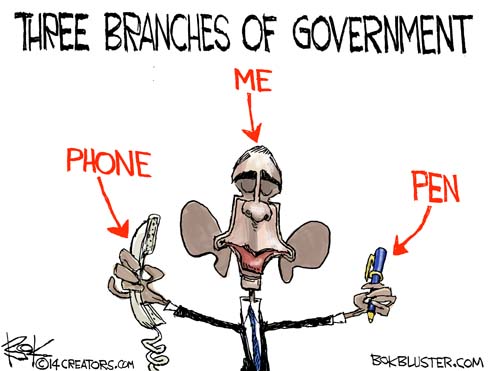
The Republican majority in the U.S. House and the U.S. Senate are a direct result of Obama's unwillingness to work cooperatively with Congress towards any of several mutually shared goals.

If Hillary Clinton is not the next president, that outcome will also be a direct result of Obama's unwillingness to work with Congress.